
Important historical document unearthed
Margrit Villinger, who had once served as authorized signatory and secretary to KD Dr. Walter Hempel, kept a war diary from 1939 to 1945.

The 200th anniversary of Köln-Düsseldorfer is the perfect opportunity to look back on the past decades. Much of the company’s history has already been documented in books and articles, including the period of National Socialism and the reconstruction following the end of World War II. Only the period during the war remained largely unknown. This gap can now be filled to some extent.
FROM ARENFELS CASTLE BACK TO COLOGNE
During research for the anniversary, the war diary of the Cologne-Düsseldorf Rhine Steamship Company came to light. It was kept by Margrit Villinger, authorized signatory and secretary to the chairman of the board, Dr. Walter Hempel. It was known from secondary sources that this diary existed, but the records had been lost. The obvious assumption: Like so many documents, files, records, and books, they had been lost in the turmoil of the postwar period. Especially since the return to Cologne in early June 1945 from Arenfels Castle near Bad Hönningen—where the KD had been evacuated due to the intense air raids on Cologne—must have been an enormous feat. Bureaucratic and logistical hurdles had to be overcome. At that time, Bad Hönningen was in the French occupation zone, while Cologne was in the British zone. Only four truckloads had been approved for the move.
KD MEMBER SCHMITZ SECURED THE COPIES
The originals have still not resurfaced, but a prudent individual made copies of the diary, which spans three notebooks. The copies do not reveal when this was done or who did it. But we are grateful to whoever ensured that the material was preserved. Norbert Schmitz, who served as CEO of Köln-Düsseldorfer until 2015, spent many years privately KD and collecting items related to KD . These include historical travel guides, maps, posters, photos, documents, and old menus. And, of course, the copies of the diary. He has now donated the majority of his collection to the KD on permanent loan.
The diary offers a sober yet intimate glimpse into the day-to-day operations of a company that was in excellent shape in 1939. It owned 28 ships of its own. Fifteen ships belonging to the “Nederlandsche Stoomboot Reederij,” with which a joint operating agreement had been in place since 1857, also sailed for the KD. As the war years progressed, the tone of the entries became increasingly emotional


PLANS IN THE EVENT OF MOBILIZATION
The first part of the war diary begins with the “Plan for the deployment of our ships in the event of mobilization.” The entry is dated September 22, 1938. Then work on the diary ceases for nearly a year. On September 6, 1939, Margrit Villinger notes information about several ships. Next to the steamers “Schiller” and “Overstolz” and the motor vessels “Beethoven” and “Graf Zeppelin” is the notation “at special disposal”—without further explanation. A few days earlier, on September 1, 1939, World War II had begun. Just how dramatically and devastatingly the war affected all areas of life, both private and business, becomes KD even in the few excerpts from this historical account of KD history listed here.
May 1940
Disruptions to passenger service due to enemy action. Due to the danger of mines, service was suspended above Rüdesheim (May 15), Koblenz (May 16), and Cologne (May 29).
“… Unfortunately, telephone service between Cologne and Düsseldorf is particularly bad right now; calls usually don’t go through all day.”
May 6, 1941
Since the laundry and linen rental company “Frauenlob” no longer supplies our ship’s caterers, and since we, on the other hand, place great importance on ensuring that (!) the tables on the upper deck are also set, we have purchased the existing stock of 1,800 tablecloths at a price of approximately RM 9,000 for resale to the ship’s caterers, most of whom do not have their own tablecloths. It is impossible to find another rental agency during the war that can provide tablecloths in sufficient quantities.
April 30, 1942
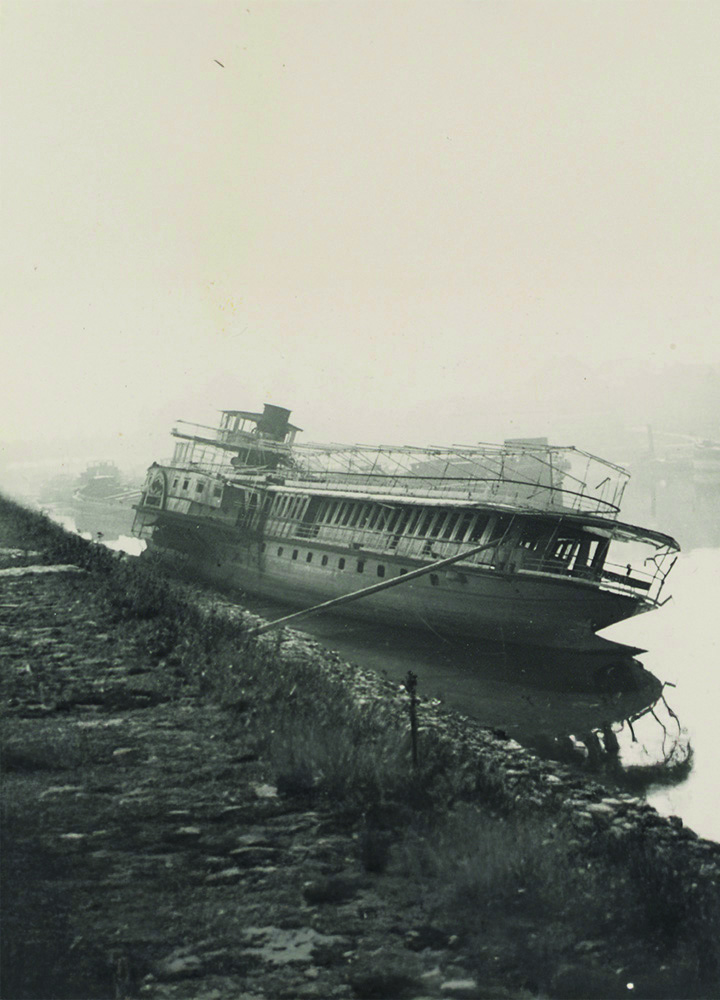
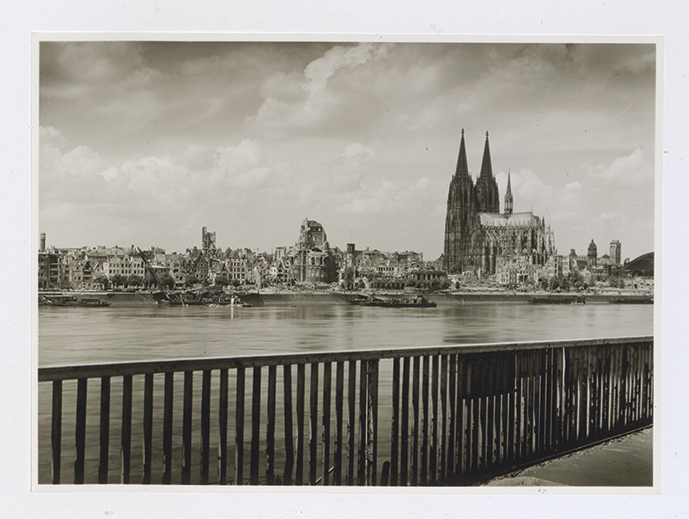
The city of Cologne has recently suffered significantly from air raids—by far the most of any West German city—particularly on the nights of April 5–6, 10–11, 22–23, and 27–28. Last night, the city sustained what is likely its most severe damage to date due to numerous fires—70 major fires alone! …. Of the five KD located within the Cologne area … only the steamship “Rheinland” was hit by an incendiary bomb.
June 15, 1943
The steamship “Kaiserin Friedrich” is expected to be chartered to the Cologne (SS) operational unit to house political prisoners who will be employed in salvage and cleanup operations. … Compensation is likely to be provided under the Reich Benefits Act.
August 25, 1943
The disruptions to telephone service caused by the air war are having a very adverse effect on our overall operations. For all of our Cologne facilities, there is only a single emergency line in the administrative building. … Unfortunately, telephone service between Cologne and Düsseldorf is currently in particularly poor shape; calls usually cannot get through all day.
October 30, 1944
In view of the extremely tense situation in Cologne, the Cologne administrative office was relocated at short notice to Hönningen, Arenfels Castle … … At first, only the bare essentials in terms of files and office supplies were taken along. Various items—important files, writing materials, furniture, etc.—had already been moved to Arenfels several weeks earlier. The office consists of a single large room, heated by a potbelly stove. In the corner stands the bathtub of the late Countess.
January 11, 1945
All along the Rhine, there is a shortage of light, fuel, bread, and other essential goods. … Mail reached Hönningen on January 10, 1945, for the first time since December 24, 1944. … Long-distance connections have been scarce for a long time and KD not KD possible at all for several days now. … Nevertheless—the KD , together with all employees present at “Arenfels,” KD the New Year on New Year’s Eve (!) with a determined “NEVERTHELESS” in a reasonably festive atmosphere.
March 7, 1945
March 2 is said to have been the worst air raid on Cologne to date. We know no further details. Here at Arenfels Castle, the windows have been rattling nonstop. According to rumors, the Americans are now said to have entered Cologne. There appear to be artillery strikes not too far from here. Rumors are spreading that the enemy has crossed the Rhine at Remagen. It is time to prepare the red wine cellar designated for this contingency for a prolonged stay there.
September 15, 1945
On March 8, the rumor was confirmed that (!) the Americans had succeeded in crossing the Rhine via the Remagen Bridge. As the artillery fire was drawing dangerously close, we moved into the wine cellar on the night of March 8–9. Stoves were set up, and beds, kitchenware, and all kinds of household items were brought down. Typewriters, office machines, and the most important files were also brought down. Everyone—there were over 50 people in the cellar—was assigned a spot and brought down whatever personal belongings they considered essential to “save.”
A CENTURY'S WORTH OF WORK GOES TO WASTE
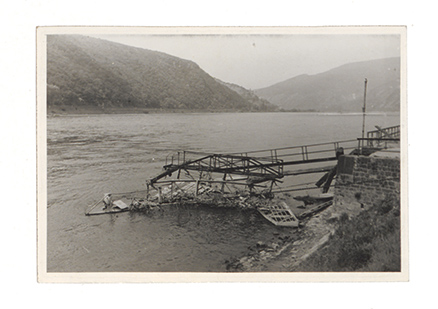
Life in the cellar lasted a week. On March 13, the German Wehrmacht withdrew. … Arenfels raised the white flag. … The way was clear for the enemy, who, however, did not approach the castle until March 15. … The guns are silent; World War II is over, even though the peace treaties have not yet been signed and the terms are not yet known. … The war diary has come to an end; will there ever be a future generation in our company for whom these records were intended? Our ships have been destroyed save for a few remnants, our old files have been scattered to the four winds; the work of a century has been shattered.
“All along the Rhine, there is a shortage of light, fire, bread, and … goods.”
REBUILDING A BUSINESS
It didn’t come to that. Margrit Villinger continued her entries through 1952. In a follow-up volume that served as both a retrospective and a look ahead. This notebook was no longer titled *War Diary* like the two previous volumes, but *Diary of the Destruction and Reconstruction of a Business*. It ends with the sentences: “Around the turn of the year 1951/52, our hopes revolve around a new building.” But because loans were still outstanding, “we must content ourselves for the time being with planning the ‘most beautiful ship.’”